Even though my interest is mainly in Anglo-American traditions, I have included religious songs from both white and black traditions.
Black Spirituals
The black material, usually called "spirituals", have mostly come from the early 19th century slave days. The roots of this music lie in west Africa. The development of this body of spiritual songs began when slaves in America began to adopt Christianity. This process is much more complex than I can describe here and it is thoroughly explained in Sinful Tunes and Spirituals by Dena J. Epstein. There are many more black spirituals than I have included here. My selections are ones that are known to me from various sources, printed or recorded.
White Spirituals and Shape-note Hymns
The white material evolved from European traditions that produced the "shape-note" hymnals of the 18th and 19th centuries. While some versions include credit for melody, lyrics or both, it is usually the writer of the lyrics that is known. A good example of this is "Amazing Grace". The melody, known as "New Britain" is traditional but the lyrics are by John Newton whose name always appears when it is published. Since my focus is more on the melodies than the lyrics, I have listed the items in this section by the melody name.
The hymns in this section are my selections from various sources where the melodies are usually of folk origin and credit is given to the arranger of the harmonies or the first known publisher. Most hymns in this section are from the body of shape-note hymns developed in the late 18th and early 19th centuries in this country. The usual structure of these hymns is:
|
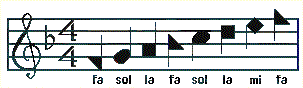
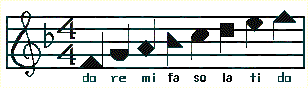
The tunes were usually printed using either a four syllable system using the Fa Sol La Fa Sol La Mi Fa scale or a seven syllable system familiar to us as the Do Re Mi Fa Sol La Ti Do scale.
 |
 |
A list of the best known early 19th century shape note hymnals:
| Title | Date | Shapes | Compiler | ||
| Wyeth's Repository of Sacred Music | 1810 | 4 | John Wyeth | ||
| Wyeth's Repository of Sacred Music, Part Second | 1813 | 4 | John Wyeth | ||
| The Kentucky Harmony | 1816 | 4 | Ananias Davisson | ||
| The Missouri Harmony | 1820 | 4 | Allen D. Carden | ||
| Songs of Zion | 1821 | 4 | James P. Carrell | ||
| Supplement to The Kentucky Harmony | 1825 | 4 | Ananias Davisson | ||
| A Compilation of Genuine Church Music | 1832 | 4 | Joseph Funk | ||
| The Southern Harmony | 1835 | 4 | William Walker | ||
| The Sacred Harp | 1844 | 4 | B. F. White | ||
| The Harp of Columbia | 1848 | 7 | W. H. and M. L. Swan | ||
| The Herperian Harp | 1848 | 4 | William Hauser | ||
| The Social Harp | 1855 | 4 | John G. McCurry | ||
| The Christian Harmony | 1866 | 7 | William Walker | ||
| New Harp of Columbia | 1867 | 7 | W. H. and M. L. Swan | ||
| The Olive Leaf | 1878 | 7 | William Hauser / Benjamin Turner | ||
An excellent resource to learn about shape note hymn singing can be found on the internet at http://fasola.org. This site includes links to youtube videos of singings. The introduction to the 1964 facsimile edition of The Southern Harmony also gives a good historical prospective.
There is a story connecting The Southern Harmony and The Sacred Harp. William Walker and Benjamin Franklin White were both musicians and hymn writers who happened to have married sisters. They collaborated on the compilation of The Southern Harmony and William Walker took the manuscript to Philadelphia for publication. When the book appeared in print, only William Walker's name appeared as the author. The repurcussions in the family can only be imagined. Benjamin Franklin White started over on his own and nine years later published The Sacred Harp under his own name.
William Walker made only a few revisions to The Southern Harmony, mainly editorial corrections. A century later when interest in shape note singing was revived, the book was reprinted in facsimile editions and no additions have been made. The Sacred Harp, however, has continued as a changing publication and has been amended and extended with new material.
The sources in my library are:
|
The lyrics shown for these hymns are those from the above three sources. Some of these melodies are now used for other lyrics in modern hymnals, following the tradition of using various lyrics with the same metrical structure to any melody using that structure. I have not included the lyrics used lately in the Lutheran hymnals with which I am familiar but have documented only the original(s) as presented in my sources. I have included references in the notes for each hymn when the melody has been recycled for use in the Lutheran publications The Lutheran Book of Worship (LBW), With One Voice (WOV) and Evangelical Lutheran Worship (ELW) or in the Anglican Songs of Praise.
Hymns derived from traditional sources are usually called "Spirituals". Depending on the source and tradition, they are commonly called "black spirituals" or "white spirituals". In some areas of the south, spiritual songs, like dance tunes and secular vocal music, show a combination of both black and white styles.
Some excellent studies in this area are:
|
Shaker Hymnody
The United Society of Believers in Christ's Second Appearing, more commonly known as the Shakers, were a millenarian restorationist Christian sect founded circa 1747 in England and then organized in the United States in the 1780s. They were initially known as "Shaking Quakers" because of their ecstatic behavior during worship services. Espousing egalitarian ideals, women took on spiritual leadership roles alongside men, including founding leaders such as Jane Wardley, Mother Ann Lee and Mother Lucy Wright. Mother Ann Lee and eight other believers emigrated from England and settled in Revolutionary colonial America, with an initial settlement at Watervliet, New York in 1774.
They practiced a celibate and communal utopian lifestyle, pacifism, uniform charismatic worship and their model of equality of the sexes, which they institutionalized in their society in the 1780s. They were also known for their simple living, architecture, technological innovation, music and furniture.
During the mid-19th century, an "Era of Manifestations" resulted in a period of dances and songs inspired by spiritual revelations. At the peak of their growth in the mid-19th century, there were 2,000 – 4,000 Shaker believers living in 18 major communities and numerous smaller, often short-lived communities. External and internal societal changes in the mid- and late-19th century resulted in the thinning of the Shaker community as members left or died with few converts to the faith to replace them. By 1920, there were only 12 Shaker communities remaining in the United States. As of 2019, there was only one active Shaker village: Sabbathday Lake Shaker Village in Maine. Consequently, many of the other Shaker settlements are now museums. As of 2022 there were only two surviving believers living at Sabbathday Lake.
The Shakers composed thousands of songs and also created many dances; both were an important part of the Shaker worship services. In Shaker society, a spiritual "gift" could also be a musical revelation and they considered it important to record musical inspirations as they occurred.
Scribes, many of whom had no formal musical training, used a form of music notation called the letteral system. It was somewhat similar to the ABC notation system used in this website, using letters and symbols to represent notes instead of standard notation. While the songs were written down, they were often transmitted between communities by word of mouth and letters which often generated variations as in other oral/aural traditions.
Initially Shaker music was monodic, that is, composed of a single melodic line with no harmonization. Instead of lyrics, the Shakers sang syllables and words from "unknown tongues" similar to the fasola method of shape note singing with syllables. Some scholars think that many of them were imitations of the sounds of Native American languages. By the mid-nineteenth century they had changed their tradition to harmonize the melodies, add lyrics and print hymnals.
A song published in Millennial Praises (1813) summarizes the Shaker community's feeling about song and dance:
We love to dance, we love to sing,Two references for information on the Shakers and their music are:
We love to taste the living spring,
We love to feel our union flow,
As round and round and round we go.
|