It describes events in the Old Testament, specifically Exodus 8:1:
"And the Lord spake unto Moses,in which God commands Moses to demand the release of the Israelites from bondage in Egypt.
Go unto Pharaoh, and say unto him,
Thus saith the Lord,
Let my people go, that they may serve me"
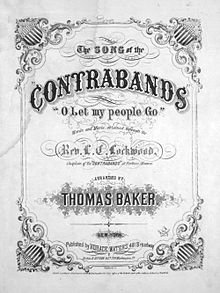
Although usually thought of as a spiritual, the earliest recorded use of the song was as a rallying anthem for the "Contrabands" at Fort Monroe in Virginia's Hampton Roads sometime before July 1862. (In August 1861, the Union Army and the United States Congress determined that the US would no longer return escaped slaves who went to Union lines and classified them as "contraband of war", or captured enemy property.) Early authorities presumed it was composed by them. Sheet music was soon after published, titled "Oh! Let My People Go: The Song of the Contrabands" and arranged by Horace Waters. L.C. Lockwood, chaplain of the Contrabands, stated in the sheet music the song was from Virginia, dating from about 1853.
It was published by the Jubilee Singers in 1872.
William Faulkner titled his novel Go Down, Moses (1942) after the song. In Margaret Mitchell's novel Gone with the Wind, slaves from the Georgia plantation Tara are in Atlanta, to dig breastworks for the soldiers and they sing "Go Down, Moses" as they march down a street.
The song was made famous by the singing of Paul Robeson. It was also recorded by Louis Armstrong, Fats Waller, Archie Shepp, Hampton Hawes and many others.
It is included in some Passover Seders in the United States and is printed in Meyers' An Israel Haggadah for Passover.
It has been published in 49 hymnals. The lyrics shown here are from ELCA's With One Voice.